Interview with Language Addict Timothy McKeon

Today we feature Timothy McKeon, a herbalist who speaks quite a few languages. Some I haven’t even heard of such as Tok Pisin or Dehong Dai. In his interview he will answer what languages he speaks, his strategies and what keeps him motivated.

IMG_0250

Tell us a little bit about yourself and your background.

My name is Timothy, and I’m a language addict.  Ever since I can remember, I’ve been fascinated with languages.  As I grew older this fascination slowly ripened into full-blown obsession with learning languages, learning about languages, comparing languages, listening to languages, breathing languages, etc.  In university I studied linguistics, but my real passion is for the actual process of learning a language, picking it apart, finding patterns, exploring accents, understanding how it all works.  Once I can read a novel and express myself freely in a language, my enthusiasm wanes a bit, and it’s time to move on to the next one.

What languages do you speak?

I speak Irish, English, Spanish, Mandarin, French, and German all more or less fluently.  I can read Latin.  I can have social conversations in Yiddish, Portuguese, Italian, Swedish, Cantonese, Sichuanese, Breton, Hindi, and Dutch and have more basic conversations in Hebrew, Galician, Ladino, Finnish, Bengali, Catalan, Esperanto, Japanese, Scots Gaelic and Shanghainese.  Beyond those, I’ve dabbled in Uyghur, Korean, Tibetan, Tamil, Sanskrit, Pali, Lakota, Halkomelem, Manx, Welsh, Cornish, Tok Pisin, Luxembourgish, Norwegian, Danish, Icelandic, Latvian, Estonian, Taiwanese, Russian, Polish, Guaraní, Xhosa, Telugu, Tamil, Manchu, Arabic, Dehong Dai, Toisanese and Hakka.  It’s out of control.

 Do you dream in a foreign language?

Yes, quite often.  People often say that you know you’re really fluent in a language when you start to dream in it, but I haven’t found that to be true.  I constantly dream in languages I don’t speak very well at all.  I’ll stumble over words and try to work out the proper conjugation or tense all as part of my dream.  Once or twice I’ve had dreams of nothing more than just doing grammar exercises.  I guess that probably means I’m not getting very restful sleep!

What do you think of constructed languages? Would you be interested to learn one?

I really love the idea of constructed languages.  I see it as a form of creative expression using linguistic concepts as the medium, drawing from natural languages (or not) in order to create an entirely new mode of communication. But what really fascinates me is the kind of living culture that develops around constructed languages.  I’ve recently started exploring the world of Esperanto, and it’s amazing to me that there is an Esperanto culture and a set of values that many Esperantists adhere to, i.e. universal understanding, peace, social responsibility.  Zamenhof created Esperanto as a kind of utopian language, and I think it’s really exciting that over 125 years later that same mentality has continued to flourish through this completely artificial language.

How has your strategy to learn new languages changed over the years?

Well, it is true that the more languages you learn, the easier it becomes to continue learning even more languages.  With that in mind, I would say I tend to tackle language families (or at least language family branches) nowadays rather than just a single language.  I’ve become really interested in how languages relate to each other, so it’s no longer enough to just learn one language in its standard, static form.  I become too curious about what neighboring languages look like or what happens in the different regional dialects of a language, and soon enough I’ve got Polish, Russian, Ukrainian, and Czech books spread out in front of me when all I really wanted was to learn a few things about Polish.  Chinese languages are really great for this kind of exploration because they are all related to and derived from Classical Chinese and are all united under more or less the same written form, but have diverged and developed so distinctly over the centuries.  It’s fascinating.

What is your definition of fluency?

This is a tricky question.  You don’t want to make false claims about your abilities, but you shouldn’t sell yourself short on your accomplishments with language learning either.  Generally, I say if you can live your life in a language comfortably, then you’re fluent.  That means you can make friends, do your job, watch the news, read a book, joke with someone, have a deep conversation, sing a song, consult a psychic, fall in love, etc. – all in said language.

What keeps you motivated to keep learning?

That varies from language to language, but generally it’s something in the arts and culture associated with a language that keeps me going back.  I was recently in Hong Kong, which should provide enough motivation to keep working on Cantonese, but what really got me to spend serious time studying was going to the Cantonese opera.  The poetry, jokes, puns, and overall spectacle of it really inspired me to up my game with Cantonese.  When I hear sean-nós songs in Irish, I feel the urge to turn back to Irish poetry or start reading old stories again.  Kishore Kumar songs from old films get me to crack open my Bengali books.  It’s always something creative that gets me motivated.

Do you watch movies to practice your languages?

I’ll watch movies to keep up languages that I know pretty well, but if I want to practice a language that’s newer or less familiar to me, then trashy TV is the absolute best.  Terrible reality shows like Top Model (from whatever country) or ridiculous soap operas are perfect for improving listening skills.  They tend to be completely predictable, follow a formula, and never introduce particularly complicated concepts – it’s ideal for gaining confidence in listening to and understanding a new language.

Have you ever started a new language and then given up for some reason?

I do find that some languages just don’t grab me the way others do.  Why am I obsessed with Finnish, while its neighbor Russian just doesn’t hold my interest?  I have no idea.  Past lives…?  Anyway, this sort of arbitrary lack of gravity towards some languages would be the only reason I would stop studying them.  And even then, it’s never really a full stop.

To learn more about Timothy please visit his web site at https://collectanealinguistica.wordpress.com/.


Polyglot Nathalia interview

In today’s interview blog post Portuguese polyglot Nathalia from PolyglotNerd.com tells us about her language learning strategies.

Tell us a little bit about yourself and your background.

I’m a Brazilian girl who always loved foreign cultures, travel and languages. When I was a child I collected news from others countries. My dream country was Spain, therefore, Spanish was the first language I learned, I studied it when I was 13 in a language school. The second language I learned was English, when I was about 18. I watched endless hours of American television and somehow I ended up learning. After that, I stopped learning languages due study and work. About 3 years ago I started to learn French and I decided to really dedicate myself to my blog, as a way to motivate myself.

What languages do you speak?

My native language is Portuguese, as I said I speak English, Spanish and French. Right now, I’m studying German.

Do you dream in a foreign language?

I used to dream in English before, but not anymore. In rare occasions I dream in Spanish or French, this happens usually when I study the language for more than 4 hours or when I’m living in a foreign country.

What do you think of constructed languages? Would you be interested to learn one?

I think they’re great idea. I’d like to learn Esperanto; I heard that it is an easy language to learn and that learning it can help to learn others languages. But, I have two reasons to not learning it immediately: first, there is no real culture linked to Esperanto; second, I have a long list of languages I’d like to learn and Esperanto is not a priority.

When you learn a new language do you always follow the same strategy?

My first two languages I learned in very different ways. Spanish in a language school and English watching movies. But, I believe that the two most important things that help me with these languages were: emotional connection and making them part of my life. With French I studied alone, without contact with French people and without an emotional connection with the language, therefore iit took me a long time to feel comfortable speaking to a French person. But, I’m trying to learn with my mistakes, I don’t have a perfect strategy, but I follow some guidelines I created to myself: first I learn the pronunciation, after that I try to acquire vocabulary. I always listen it a lot and later I’ll try to speak with a patience native speaker.

Do you have a favorite language?

For me, languages have personalities, there is no language I’d use in all situations. Probably, my favorite language is Spanish. I love to listen to music in Spanish, for me Spanish sounds more emotional. I also love the rhythm, it’s perfect to dance. English for me is a practical language, every time I search for an information, I do that in English. If I’m speaking to a foreigner, no matter the nationality, I’ll speak in English. French for me is a “special” language, only to be use in special occasions or important discussions, it’s full of culture and personality.

What would you recommend a new language learner? How to get started?

First, choose one or two methods, you don’t need 10.000 materials. Don’t give up, at the beginning I always have a feeling I’ll never be able to understand anything. And, start by the pronunciation, it’s the hardest thing to correct later. Also, forget the grammar, you can check it later.

How has speaking multiple changes changed you as a person?

I’m a shy and reserved person, so I’m very quite person. But, to speak a language, well, it’s obvious, you have to speak. So, learning a language made me a “less shy” person, that’s the first thing. The second thing, made me more open and tolerant to different people and cultures. I have a feeling that I’m more tolerant when I visit a country or meet foreign people than some monolinguals.

Do you travel more now since you’ve learned a lot of languages?

This is the story of my first travel: I did one semester in a English language school in Brazil, and for me was a waste of time, and that was exactly what I told my father. So, I convinced him that, instead of paying me a language school for years, I’d save the money to spend one summer in US, so I did it for 2 years.

The result: Two years later, I was in US, I had a J-1 visa, that allow me to work in US during that summer and was perfect. The money I saved helped me to get there and my small salary helped me to cover the expenses while I was there. And, of course, I practiced English.

Also, recently, I spent 2 months in France, only studying, I believe that without this, French would never stuck in my head. So, yes, I travel more and I use language learning as a good excuse.

Do you watch movies to practice your languages?

As I learned English watching TV, I always say that it’s possible to learn a language with the help of movies. I believe that after the A1 level we should start to use movies in the learning process. It’s a good way to test your knowledge and to see how the language works in a real situation. Nevertheless, just watching movies won’t make you a language expert. I have a method for watching: first, I’ll watch the movie only for entertainment; then I’ll look for the original subtitles and watch it. If there is any unknown word, I’ll take a note (usually I print the subtitles). After that, I extract the audio and listen to the audio, if the audio is difficult I’ll read along, if is easy I’ll only hear. That helps me a lot.

Have you ever started a new language and then given up for some reason?

Yes, Japanese. I started when was in University and gave up. I don’t remember the exact reason, probably lack of focus. But, having the perspective I have today, is something I regret. I plan to study it again, someday.

To learn more about Nathalia please visit her blog PolyglotNerd.com. 


Ellen Jovin Interview & Polyglot Conference

In today’s interview blog post Ellen Jovin tells us about the upcoming polyglot conference in NY she’s co-organizing with Richard Simcott and Alex Rawlings and about her language learning methods. 

11998587_1039366156087306_849691023_n

Tell us more about the Polyglot Conference in NYC? How much work is involved in organizing it?

Polyglot Conference NYC 2015 will bring hundreds of linguaphiles — polyglots, linguists, language enthusiasts — together in the world’s most multilingual city to hear some wonderful speakers and hang out and talk and network with one another. It will be held at the SVA Theatre in Chelsea, which is a bustling neighborhood in Manhattan full of restaurants, bars, varied architecture, and one of my favorite places to take visitors, High Line Park. The dates are October 10 and 11, but there will be various activities before and after, as many people are arriving early and/or leaving late. I am beside myself with excitement. It’s a lot of work to organize, but in my view gracious hosts are not supposed to make a point of that!

Who is organizing it?

I am working with English polyglot Richard Simcott, who originated this conference series in Europe, and Alex Rawlings, another English polyglot, who worked with Richard on the most recent Polyglot Conference in Novi Sad, Serbia. There have been two in Europe already, so this will be the third, and I joined Richard and Alex in order to bring this event to the U.S. for the first time. Both are truly impressive polyglots, and good, thoughtful people as well, so it has been a joy and an honor to work with them.

Is it the first time you organize something like that?

This is old hat for Richard and Alex. As for me, I am accustomed to organizing events for Syntaxis, a business I have had with my husband for 15 years. Those events are smaller, but they are nonetheless language-related undertakings in Manhattan requiring some similar kinds of preparatory activities.

Tell us a little bit about yourself and your background.

I am a linguaphile. I am attracted to language. I cannot help it; it is hardwired into me. I studied languages in college, then returned to them as an adult. Everything I have done in my adult life — teaching, writing, etc. — has revolved around my love of language, whether my native language or foreign ones.

What languages do you speak?

I do my best work in English. But I also speak Spanish, German, French, Italian, varying degrees of Portuguese depending on when I last examined it, and bits and pieces of a bunch of others. Right now I am reviewing previously completed lessons in Polish, Russian, Greek, Arabic, Hebrew, and a few other languages.

Do you dream in a foreign language?

Sometimes. Last night I dreamt that I missed a flight from Paris to JFK, and in the dream I was on a cell phone on the streets of Paris in the pouring rain, trying to negotiate a new flight in French so I could get back to New York.

What do you think of constructed languages? Would you be interested to learn one?

I am less interested in constructed languages than in the people who construct them. I find some of the conlangers fascinating — incredibly creative and knowledgeable linguistically. It’s fun to hear them talk. I like reading the posts in the conlang groups. Half the time I can’t even understand what they’re talking about. It’s fantastic.

When you learn a new language do you always follow the same strategy?

More or less. I like to start with audio lessons, then quickly jump in with the writing system and grammar after I get a basic feel for a language’s oral qualities and structural features. I am unusually fond of grammar, I would say. I love doing grammar exercises. I love conjugating verbs. I hate not knowing how a language is put together.

How has your strategy to learn new languages changed over the years?

I don’t think it has changed all that much. I am pretty stubborn and I know what I like.

Do you have a favorite language?

I really love Italian. There are so many ways to say “the.” And Italian feels good in my mouth when I am pronouncing it. I am feeling very fond of Levantine Arabic right now, too.

Which resources do you normally use most?

Pimsleur, grammar books, Memrise.

What do you think of LearnWithOliver.com?

Are you fishing for compliments? You already know I really like it. It is carefully edited and responsible, and I dig that. I have used it for a whole bunch of languages.

What is your definition of fluency?

Fluency has arrived when I can express a large percentage of the things I want to say in a language — even if they don’t always come out beautifully. The important thing is being competent enough to reroute into another way of wording something if I get stuck.

What keeps you motivated to keep learning?

It is intensely pleasurable to me.

Which language do you think is the most romantic?

I am not romantic, so I don’t care about which language is the most romantic. I just like expressing myself.

And what point would you recommend reading up on grammar?

This is a personal choice. I like to start in on grammar very early on. If you hate grammar, then I wouldn’t recommend doing that. Whatever you use, you will make less progress if you don’t actually like it, so it is important to reconsider your materials if they aren’t working for you. Language is not a one-size-fits-all undertaking.

Who do you think is the most accomplished polyglot you’ve met?

I have a few in mind, but I cannot know the answer to this question, because I do not at present have the skills to test the most accomplished polyglots I’ve met. They know too much. Fortunately, I am not concerned about who the most accomplished one is. I just really dig being around people who like language.

How important do you think talent is when learning a language?

I have noticed that many people hate talking about talent. I don’t get that. I am not very good at yoga. So what? That doesn’t mean I can’t do yoga, or that I can’t improve at yoga, or that I can’t benefit from yoga, or that I can’t enjoy yoga. It just means you will not see me on the stage at the national championships.

Do you use mnemonics to learn new words?

Only when I’m really desperate and simply can’t remember a word no matter what I do. I am otherwise not into mnemonics. I do like saying that word though. Mnemonics. Mnemonics. Mnemonics. It’s cool!

To learn more about Ellen Jovin please visit her blog “Words & Worlds of New York”. To get more information about the upcoming polyglot conference in New York please click here.


Entschuldigung mein Deutsch ist nicht so gut!

“Entschuldigung mein Deutsch ist nicht so gut.” This phrase got me through my first few months of living in Germany. Everything was difficult, from visiting the butcher to navigating visa procedures. Some days I wanted to hide under the covers and pretend I was still in America.

I had never studied German prior to a one-month panic before our move to Munich. After arriving I found that the vocabulary that stuck was what I used in every day life. I learned all manner of grocery store words, especially “Aktion” and “Sparpreis.” Soon I took a job as a nanny for a less-than-angelic German child who taught me the term “Gefängnis” and “Ich töte dich!” Every day I scribbled words I didn’t know into a tiny notebook for later researching.

The language came slowly. Lacking conversation partners I took every opportunity of seeing our Hausmeister to engage him in long conversations. Oddly enough he seemed less interested in sharing his thoughts on the meaning of life than in watering the garden. Soon he stopped politely inquiring about how we were finding the place. But I found other opportunities.

In general, elderly ladies are willing to converse. Once in the grocery store I asked a retiree if there was a difference between Blaukraut and Rotkohl. She gave me a dissertation on the topic! Another time I asked an older lady for directions to a dentist’s office and we would up discussing (and singing) Irish folk music.

My German has improved tremendously in the one year that I’ve lived here. I was patting myself on the back one day when my doorbell rang. It was a group of Jehovah’s Witnesses. I wanted to dodge them so I pulled out and dusted off my old phrase, “Entschuldigung, mein Deutsch ist nicht so gut.” I began to close the door but one of the gentlemen stuck his foot in. “No problem!” He beamed, “I speak English!”

Written by Katy Strange, see her blog at http://www.ourstrangeworld.blogspot.co.uk/


Flashcards in the Digital Age: A Comparison of Anki & LearnWithOliver

Today’s guest post is from Paul. He teaches English in Argentina and works for Language Trainers, which offers personalized course packages to individuals and groups. He approached me about a guest post and I suggested a comparison of Anki and our website. As I would be biased it’s perfect for a third party to compare both sites. Anyways here we go:

Flashcards are a classic vocabulary-building tool that language learners have been using for ages. Nowadays, far from their paper-based origins, flashcards are now available on a variety of digital platforms, and offer high-tech algorithms to help you learn new foreign-language vocabulary as fast as possible.

Two popular choices for language learners are Anki and Learn with Oliver, the latter of which is produced by the language-learning gurus at Antosch & Lin. Both of these services use spaced repetition, which means that they present vocabulary at specific intervals based on how well you know the word. For example, if you know a given vocabulary item very well, it may be shown to you once a week or once a month; conversely, if you continually forget a specific word or phrase, it will be presented to you more frequently until you memorize it. This way, you spend more time reviewing the words you actually need to remember, whereas words you already understand well are presented only now and then so that they don’t slip from your memory.

Despite sharing a similar basic idea, Anki and Learn with Oliver are quite different, largely due to the fact that Learn with Oliver is specifically designed by and for language learners, whereas Anki can be used for a variety of purposes. Both are valuable learning tools, but for the serious student, Learn with Oliver provides some key features that Anki lacks, and will help you learn new vocabulary faster than ever before.

Anki

Anki is an app that you can use on your computer or smartphone. The idea itself is simple: it’s a basic, user-friendly version of digital flashcards which can be used for any type of information. What’s impressive and interesting about Anki is not the flashcards themselves, but rather the algorithm going on in the background which decides when to show the cards to you.

Here’s how it works: you create a “deck” of flashcards (for language learners, this will consist of foreign-language vocabulary). You can download decks that other users have created for your language, or you can create your own decks with words that you come across in your daily foreign-language adventures. This is particularly useful if you’re reading a foreign-language book and want to remember some of the unfamiliar words and phrases that you encounter.

Learnwitholiver_pic1

Then, you can review the cards in your deck whenever you’d like. Depending on how easy it is for you to recall the word, Anki will show it to you again at differing time intervals. If you had no idea what the word meant, it will show you in the next couple minutes; if you were super confident about it, it will show you in a few days. The time intervals are decided by your own judgment as well as your answering history, so if you’ve repeatedly forgotten a word, Anki will present that flashcard to you more frequently.

And that’s basically it! Perhaps its simplicity is one of the reasons why Anki is so popular among language learners; it’s incredibly easy to use. In fact, its shortcomings only become apparent when compared to a similar flashcard service that’s specifically tailored to the needs and goals of language students.

Learn with Oliver

Enter Learn with Oliver. As mentioned above, Learn with Oliver is designed by and for language learners, and this is clear from the start. At its core, Learn with Oliver is conceptually similar to Anki: it offers flashcards that utilize spaced repetition. However, flashcards only scratches the surface of what Learn with Oliver offers. Several other reviewers have described Learn with Oliver as “flashcards on steroids”, and this turns out to be quite an apt description.

 First off, Learn with Oliver comes with pre-loaded decks of flashcards that have thousands of items each. Of course, like Anki, you also have the option of adding your own words to the mix. Unlike Anki, however, these decks are highly customizable: you can set your vocabulary level, turn off English translations, see real-life example sentences that contain the word, view images of the word, see possible derivations and conjugations of the word, and remove cards from the deck when you don’t need to review them.

Learnwitholiver_pic2

My favorite feature about Learn with Oliver is that all flashcards include an audio component (in Anki, only a handful of decks come with audio), which are pronounced by native speakers. Therefore, you can listen to the word or sentence that you see on the flashcard, which is an excellent way to associate the text and pronunciation in your brain.

Learnwitholiver_pic3

 Further, there are a plethora of other language-learning features aside from the flashcards themselves. After reviewing a deck (or two), you can assess your skills with an interactive test. There are language-learning games in which you can save your high scores and compete with yourself. There are writing exercises in which you read sentences (which are also pronounced by native speakers), and are later called on to provide a translation of them. It’s possible to spend hours simply navigating the diverse array of features that Learn with Oliver offers.

Learnwitholiver_pic4

Finally, Learn with Oliver gives language learners some gentle incentive to keep their language skills sharp in the form of a daily newsletter. Unlike most newsletters, which are either ignored or end up in your Spam folder, the daily email from Learn with Oliver is a language learner’s treasure trove. It contains several vocabulary items and sentences (including word-by-word breakdowns of each one), and even has an essay-writing exercise for the brave. Best of all, you can customize the newsletter to send you just a few daily words, or up to 100, if you’re an extremely ambitious learner.

Ultimately, both Anki and Learn with Oliver are valuable tools for language learners: spaced repetition works! Pragmatists who seek a very basic flashcard system sans bells and whistles will gravitate towards Anki, which is basically as simple as it gets. But language learners who are looking to maximize as much information as possible from their flashcards — those who seek “flashcards on steroids” — will surely appreciate Learn with Oliver’s vast offerings, which come with useful, actionable, and extremely comprehensive language-learning tools.

Language learners: Have you used Anki? What about Learn with Oliver? What are your impressions of each? Leave a comment!

If you want to know more about Paul visit their Facebook page or check out their free language level tests.


5 Ways to Make Music a Part of Your Language Learning

Today’s guest post is from Shannon Kennedy. She is the blogger/language lover/adventurer behind Eurolinguiste. She is a musician first, but an avid language learner at heart. She speaks French and English fluently and is currently working towards fluency in Mandarin and Croatian. You can learn more about her and her language learning strategies of at Eurolinguiste.

Great music is that which penetrates the ear with facility and leaves the memory with difficulty.” – Sir Thomas Beechem

Why is it that we can recall almost every word to a song when it pops up on the radio as we’re driving, even when it’s been years since we’ve heard it? What is it about music that enables us to remember moments, events, and words that are only evoked when hearing a song? But more importantly as language learners, how can we harness that power and apply it to our studies?

Since its invention, music has been used as a way to teach, to keep records, to communicate and to entertain. It has long played its role in boosting memorization. So why not use this excellent memorization tool to help you with the vocabulary and grammar of the language that you’re learning?

Here are a few ways to utilize music to improve your language study:

1. Learn the lyrics to foreign language songs.

Take a moment to peruse YouTube or TuneIn to find music that you like in your desired language. The desire to learn to sing along is a must! Using music as a language learning tool is more effective if you’re enjoying yourself. A quick way to find music in your target language is to search one of the big record labels for their branch in the country that speaks the language you’re learning (i.e. Universal France, Universal Taiwan) or even Vevo France, Vevo Japan, or Vevo Russia.

I’ve also started to collect songs in the languages I’m learning on Youtube, so if you’re learning French, Croatian, Mandarin, Japanese, or Italian, you might find something that you like there.

Once you’ve found a song or two that you enjoy here are the next steps:

First, learn the words in the foreign language. Look them up online by searching for the lyrics of the song. To help get you started, here are the words for lyrics in several different languages:

  • French – les paroles
  • Spanish – letras de una canción
  • Italian – testo/parole della canzone
  • German – liedtext
  • Mandarin – ge1 ci2 - 歌词
  • Russian – slova dlya pesni

This is one of my favorite sites for transcriptions AND translations of foreign language songs.

Second, translate them into your native language. You can just paste them into Google Translate if you like, but you definitely get bonus points if you make an effort to translate what you can on your own first!

Third, memorize them and sing along! It helps with pronunciation. You’ll also pick up expressions and words that you won’t find in a textbook!

2. Set the vocabulary and sentences you’re trying to learn to the melody of one of your favorite songs.

This is a really great and proven way to help you memorize different words or phrases that you’re trying to learn. When I think of this method, I am often reminded of the episode of “How I Met Your Mother” where one of the characters forgets something important:

Traditions such as oral storytelling were maintained by performing stories in poetic and musical forms to aid the passing down of histories and stories. These stories were often performed in their poetic and musical forms because the rhythmic and melodic patterns helped those telling the stories remember them.

Music can really stick with you – that’s why you can remember the lyrics to songs years after you’ve heard them last. Applying this to language can definitely help you improve your ability to recall words.

One of the best ways to get the most out of this method is to create songs using groups of related words – colors, modes of transportation, directions, numbers, and so on. Using a random list of unrelated words may be harder to remember, even as a song, so it’s best to use several different melodies to memorize multiple lists of words.

But they don’t have to be difficult songs! They can be melodies from your childhood or the chorus of your favorite song. You can definitely get creative.

3. Listen to a set playlist while you’re studying a language.

Scientifically, music helps break information down into patterns and cues that allow us to better remember. But it isn’t just words that music allows us to remember – it’s also events. So turn your study sessions into memorable events by using a set playlist.

Using a specific music playlist as a background to our study can actually help trigger memories that surround previous study sessions, which in turn, help make your current study session more productive.

4. Use songs to practice dictation.

Songs are relatively short – usually about three to four minutes long. They often have repetitive passages too, which makes them great practice for transcription. Choose a song and get your pen and paper ready. As you listen, write down the words.

Be patient using this method! Don’t be afraid to rewind the track as many times as you need. Try to jot down the lyrics as accurately as possible, then look them up online to see how close you are.

5. Find songs you already know in your native language that have been translated into your target language (or translate them yourself).

Children’s songs like “Head, Shoulders, Knees, and Toes” and the theme from Sesame Street, or even holiday songs like “Frosty the Snowman”,  already exist in many languages and are a great starting point. They’re often quite short and simple and so learning them is an easy task. Plus you’ll very likely pick up new vocabulary!

How do you use music to improve your language study? I’d love to hear about it in the comments!

Further Reading:

Do Musicians Make Better Language Learners? on The Guardian

Music is Linguist’s Best Friend on Eurolinguiste

You can find Shannon Kennedy on: Facebook | Twitter | Instagram | Youtube


Language Learning tips from polyglot Michael McCavish

A few weeks ago I talked to one of our users (Michael McCavish) about language learning. When I heard he speaks 7 languages, I asked whether he would be interested to write a guest post for us and he delivered! Here is Michael’s take on language learning:
 
I have never really thought of my ability to speak 7 languages as in any way extraordinary. I know there are many polyglots who can speak many more. I am the founder of Michael’s English School in Osaka, Japan. Many of my students ask me the secret of learning foreign languages and this has helped to formulate my ideas on the subject. I am happy to share my thoughts on language learning and hope that they may be helpful to others who might be considering learning another language or two.
 
Nature versus Nurture
 
“You are lucky you are just good at languages.” “I am no good at languages.” “My memory sucks!” These are the sort of comments that I hear day in, day out.
 
If you think you are bad at languages, let me put your mind at ease: you aren’t! The first thing that you need to do is change your internal dialogue. Get rid of that nasty little voice in your head that tells you that you are bad at something. It quite simply isn’t true. The first thing to do is make yourself aware that you have an astounding piece of equipment, namely your brain. Remind yourself that your brain contains between 100 and 500 trillion synaptic connections, that it is dealing with possibly millions of pieces of information every second, and that YOUR brain differs very little from Einstein’s brain or the brain of Sir John Bowring, once Governor of Hong Kong, a polyglot who could speak 100 languages and was said to “know” 200!!!
 
So now that you are in a positive state of mind about your equipment, you can now do what I do when I decide to tackle a new language.
 
The first question I ask myself is, “Why do I want to learn this language?” One of the most important things about learning anything is desire. As a young boy at school, I had no interest in French. I distinctly remember getting 8% in a French exam. It was not until my parents bought a place in the South of France, where there were a lot of very beautiful French women, that my interest in French rocketed… along with my abilities!
 
Sure, if you have children, start them young, but you can learn a language at any age
 
Now, I would say that it is true that a stimulating early childhood, possibly one in which your parents are of different nationalities, will cause neurological pathways to form which help you to learn languages. In my case my father was British and my mother Dutch, so by the age of four, I was already bilingual. I believe firmly, however, that these neurological pathways can also easily be formed in later life simply through application.
 
Many polyglots are the result of circumstance. As educators will tell you, circumstance usually leads to a need and a desire to learn how to equip yourself to deal with whatever environment you find yourself in.
 
In my case, my parents spoke English and Dutch, we had a house in France, I had some very close German friends, I worked for some years in Portugal before moving to Japan, and my wife is Belarussian. Voila! Simple!
 
During the course of learning these languages and teaching languages, I have developed tricks, which help me. Yes, I use mnemonics, yes, I use loci, or a memory palace. Mine has 104 rooms with two wings, equivalent to two decks of playing cards. But these are just useful for vocab building. In brief, just as described by Anthony Metivier, I basically take a new word that I want to learn. I convert it into something that it may sound like or make a note that it is similar to a word that I know in another language, frequently making a ridiculous connection, and then I place it in a room in my mental memory palace. There is so much info out there on mnemonics and memory palaces that I will not go into it.
 
Modern Tools and Antosch and Lin’s website
 
As a teacher and a learner I am always looking to upgrade my techniques. In a modern age, we may use modern techniques. Books are good but they do not help with pronunciation. As I said before, we have an incredible piece of equipment in the brain. It is very important to bombard the brain with thousands of spoken sentences. The brain will automatically scramble everything up and later be able to use a bit from this sentence and a bit from that sentence, as it requires. Repetition is very important. I break down what I want to learn into chunks. It is very important to take a rest from studying approximately every 25 minutes. I believe this helps the brain to really absorb the material.
 
I was incredibly happy when I found the Antosch and Lin site. It was exactly what I was looking for. I use the pronunciation function. I record chunks on my iPhone and then replay those chunks frequently. Sometimes I choose chunks from the site that are theme-related. Sometimes I chose chunks that are level-related. I also use the site these days to refresh languages that I already know.
 
I think it was Nietzche who said something along the lines that “Life is about creating good habits and avoiding bad habits.” I wholeheartedly agree!
 
The walk from my house in Japan to the dojo where I practice Aikido takes about 25 minutes. So every day, I listen to 25 minutes of pre recorded sentences from the Antosch and Lin website. This has really helped me to tackle Russian. THEN I try to recall it. Far better to recall a small chunk of info than to wade through a lot of information, which you cannot recall 20 minutes later!!!
 
Further to the idea of forming good habits with regard to language learning:
  1. Personally, I do not smoke or drink alcohol. I sincerely believe that both damage the brain. It is akin to keeping your amazing equipment in good working order.
  2. Exercise is very important. A good walk outside is sufficient. Oxygen is vital.
  3. Declutter your life and set clear goals. I am fond of Zen and I always liked the idea that Einstein had several sets of the same clothing so as not to clutter his mind with what he felt were trivialities. You will not find me dressed in anything other than blues and whites. (I have to admit though that trivia can be fun. I also find that music after learning helps memory somehow!)
 Parents should help their children to form good habits
 
I am thankful for my parents. My father was an educator. He taught me that learning was fun. He introduced me to various ideas; he often told me, “we are what we eat”, “a healthy body is a healthy mind”, “by night a man, by day a man”, etc. It was he who first gave me the desire to learn, who first introduced me to the power of the brain and who taught me simple mnemonics to remember school tasks. To this day, I still remember him teaching me, “Three old Angels, Sitting On High, Chatting About Heaven” as a way of remembering tangent is opposite over adjacent, sine is opposite over hypotenuse, cosine is adjacent over hypotenuse. With these foundations, it was easy to start to use mnemonics for language learning.
 
My mother was Dutch. Not only was she keen that I should know her language but she was also a linguistic role model for me as she was also fluent in English, German and French.
 
Summary
  1. Yes, forming early neurological pathways helps but we can form them at any time.
  2. Be positive. Believe you can learn.
  3. Find out how many total immersion hours are suggested to become fluent in your chosen language and just get on with it!
  4. Foster a desire to learn.
  5. Use mnemonics and any other memory aiding techniques that you can find out about.
  6. Repetition is good along with periods of rest every 25 minutes. Use music to relax. Recall is vital.
  7. Use modern technology like the Antosch and Lin website to do repetitive pronunciation practice. This gives your brain vital speech patterns to mimic.
In conclusion I always tell my students: Watch movies, listen to songs, speak, read and ENJOY!

10 tips how you can easily remember new words

In today’s guest post, Yohana Petrovic explains how to easily remember new words.

Are you learning a new language? Or maybe just working on improving your vocabulary?

Did you stumble across a new word while reading the other night and want to remember it?

We are all always trying to remember things. Those of us who love writing are even more likely to try to learn and remember new words, whether they are in our own language or in a language that is foreign to us.

Would you like to be able to have much better recall of all new words that you are learning? Then, here are ten tips to help you out.

1. Tie New Words to Old Words in Your Memory

Let’s say that you want to remember that the word “polyglot”. First you look it up in your dictionary or type it into a search engine. You will find that the definition is “knowing or using several languages” (at least, that is the definition according to the online Oxford Dictionary). So to remember what “polyglot” means, you could link it to a word with a similar definition such as the word “multilingual”. You can find more information here.

2. Match Your New Words to Pictures in Your Mind

This time let’s take the word “vex” as an example. You just read it in Pride and Prejudice and looked it up in your dictionary. So you know that the word “vex” means “to cause someone to feel annoyed, frustrated, or worried.” How are you going to remember this new meaning? Well, what happens when you feel annoyed, frustrated, or worried? Do you get a headache? Do your brows furrow? Now, imagine a stick figure. A cartoonist would draw x’s for the person’s eyes. “Vex” sounds like “x”. So to remember “vex”, just imagine an annoyed, frustrated, or worried cartoon character with x’s in place of its eyes and eyebrows.

3. Display Your Words Around Your House

One of the best ways to learn a new word is to constantly look at it, think about it, and bring to mind what it means. A good way to do this is to put words around your house. Now, don’t just put your words that you are trying to learn in random places. Are you trying to learn the phrase “J’adore”? (It is French for “I love”.) Then, put it near something that you love.

4. Use Acronyms

What is an acronym? It is where you form a new word from the first letters of several other words. For example, let’s say you are trying to remember the words “wily,” “odious,” “rancorous,” “decorous,” and “systemic.” How can you link these random words so that you can remember them? Well, the first letter of each word, put together, spells “WORDS.” This is an excellent way for you to remember several new words at once rather than remembering the meaning of new words.

5. Try Connecting Each Word In Your Mind With a Number

Let’s say that you need to remember three different new French vocabulary words that form a sentence when put together. These words are “J’adore le chocolat.” But you keep switching up the order. So, you need to attach each word to a number so that you can remember them as a sentence. Use either picture or auditory devices to link “j’adore” with “1”, “le” with “2”, and “chocolat” with “3”. This way you can remember each word in its proper order.

6. Make an Acrostic Sentence With Your Words

Did you ever take music lessons? If you did, then you remember having to learn the names of the lines of the treble clef. To remember them, you probably learned the phrase “Every Good Boy Does Fine.” The first letter of each word corresponds to the name of one of the lines of the treble clef. You can use this device to remember practically any word, phrase, or letter. You can find more information at this website.

7. Discuss Your New Words With Someone Else

Have you ever found that you understand a concept, a philosophy, or any other idea better if you explain it to someone and then discuss it with them? Not only is this a fun process, it is a proven memory device.

8. Make Flashcards

This step is pretty self-explanatory. If you are trying to learn a new word, one good way of remembering both it and its meaning is by turning them into flash cards. Put the word on one side of the flash card and the meaning on the flip side.

9. Use Your New Words in Sentences

One of the best ways of remember either a new word or the meaning of a new word or both is to use the word in a sentence. This way you can remember the word and, by the context of the sentence, what the word means.

10. Repeat, Repeat, Repeat

One of the best, most time tested ways to remember something is to keep repeating it over and over again. Whether you are trying to learn a foreign language or just a new vocabulary word, you end up having to repeat, repeat, repeat it to learn it.

Yohana Petrovic is a writer and educator. Yohana has 10 years experience in educating and now she is a proofreader at http://globalessays.org. You can reach her on Facebook or on Twitter: @YohanaPetrovic


Italian Basics For Easier Communication

In today’s guest post, Brendon Gleaves explains the basics of Italian.

Italian is one of the most spoken languages in the world. Italy is a country that has a rich history, with the Roman Catholic having its origin in Italy. You might want to visit the country, or maybe you just need to learn the adorable language. There might be times when you could be on a job tour in Italy or you are on a special, short visit there, for that, you will need to learn Italian basics that will keep you on track.

If you need to learn Italian more effectively, you will have to practice more of it. On your trip to Italy, you will have to know some easy to say words and phrases that will help you be understood easily. These words and phrases are the once that are called the Italian basics, which are also easy to learn. It will help if you constantly practice them, for a quicker understanding, before you advance to the next level.

The Basic Words
The most common words that you would expect to say, nearly every time you meet or leave someone are the following; Some words or phrases have their pronunciation included, for the sake of avoiding, the wrong pronunciation.
• Buongiorno, pronounced, Bohn- jyouhr-no, or the informal, Ciao, meaning Hello
• Come sta, pronounced, ko-me-sta, means How are you?
• To say fine, thank you, you will reply, Bene, grazie, which is said be-ne, grat-zi.
• What’s your name – Come si chiama, said, ki-a-ma.
• My name is… Mi chiamo – ki-a-mo
• Pleasure meeting you – Piacere di conoscerla, it sounds, pya-che-re di ko-no-shayrla.
• Please – Per favore, said, peyr fa-vo-re.
• Thank you – Grazie.
• You are welcome – Prego
• Yes – Si
• No – no
• Excuse me – Mi scusi, this is said, mi sku-zi
• I’m sorry – Mi scusi
• Goodbye – Arrivederci, pronounced, ari-ve-der-chi.
• Good morning – Buonamattina
• Good afternoon – Buongiorno, this is pronounced, bon-jyior-no.
• Good evening – Bounasera
• Good night – Bounanotte

Basic Phrases
You might be in dire need of accessing or knowing anything when in a store or the bus, for that, these phrases would help you to communicate in a more understandable way.
• I don’t speak Italian – Non parlo Italiano
• Do you speak English? – Parla Inglese, this sounds like, ing-leze.
• Does anyone speak English here? Qualcuno parla Inglese?
• Help! – Aiuto, pronounced, ai-yu-to.
• I don’t understand – Non capisco
• Where is the toilet? – Dov’ è il bagno, said ban-yo.
• I speak a little Italian – So soltanto un po’ di Italiano
• This is…. (When introducing a person) – Le presento…
• What did you say? – Che cosa hadetto?
• Could you talk slowly? – Può parlare lentamente?
• Yes, I understand very well. – Si, capiscco benissmo
• Enjoy your day, or have a great day – Buoba giornata.

There are some Italian letter C that will sound -ch-, but other uses of C will sound -kah-, but you will learn more as you advance in the language. These phrases will help you to get along with people that you might meet on the way, or at a social gathering. They might also help you to know if there is an English speaking person around, who might translate more to you, or help you learn even more. Always try to pronounce them the right way, in order to avoid confusion. Nevertheless, you should know the phrases and the words, which will give the native speaker a clue of what you might need. If you attend a reputable school that has competent teachers, learning Italian is not difficult. Within a short time, you will become familiar with the basic of this language and be in a positron to communicate.

Brendon Gleaves runs LanguageHelper.net  where he discusses his best language learning techniques. Visit his website for more information.


Readlang – a language resource for advanced users

In today’s guest post Steve Ridout tells us how he started Readlang, a site suited for more advanced language learners.

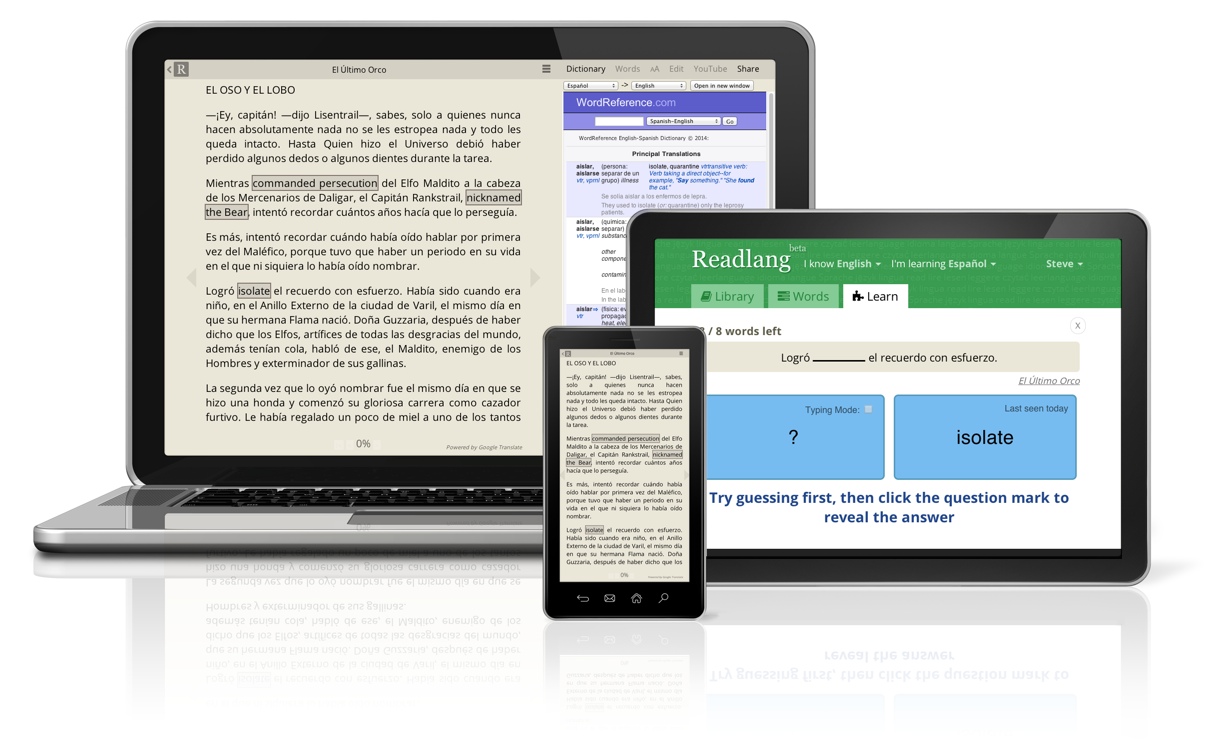
I’m Steve and I create and maintain Readlang, a language learning web-application which allows you to consume media in your target language. Designed mainly for reading novels and other long form texts, but it’s also used to read websites, watch YouTube videos, and listen to songs. The great thing about it it’s simple inline translations which allow you to quickly understand unknown words and phrases, and that it tracks your progress to provide you with tailor made flashcards based on the books and texts you love to read.

Readlang

The idea came after I’d been living in Madrid for 6 months, and wasn’t happy with my progress in learning Spanish. This was largely because I wasn’t using it on a daily basis. I would almost always talk in English at home, and I was working remotely with English speaking people. The times I would try to socialise in Spanish were difficult and stressful because I just couldn’t understand most conversations. I was falling into the typical ex-pat trap and needed to make a change.

I decided to immerse myself in the Spanish language, and chose reading as my primary habit to do this. Reading is great because it exposes you to lots of new vocabulary and isn’t stressful like talking can be, at least for an introvert like myself. And from this the site was born.

I’ve been very pleased with the response. Nearly 10,000 people have signed up so far and a lot of have told me that Readlang is exactly the app they’ve wanted for years, which is incredibly encouraging and rewarding. And some are willing to pay a small subscription to use the site very heavily. On the other hand, it’s still not providing me enough to live on, so I’m currently contracting as a software developer for a few months to stock up my savings and will return to working on Readlang full time soon.

I still use it regularly, it’s especially useful now that I’m back in the UK to have a little exposure to Spanish every day. If you’re learning a language, and are ready to start tackling simple native texts, give it try. I think you’ll like it.